
 Image 1 of 3
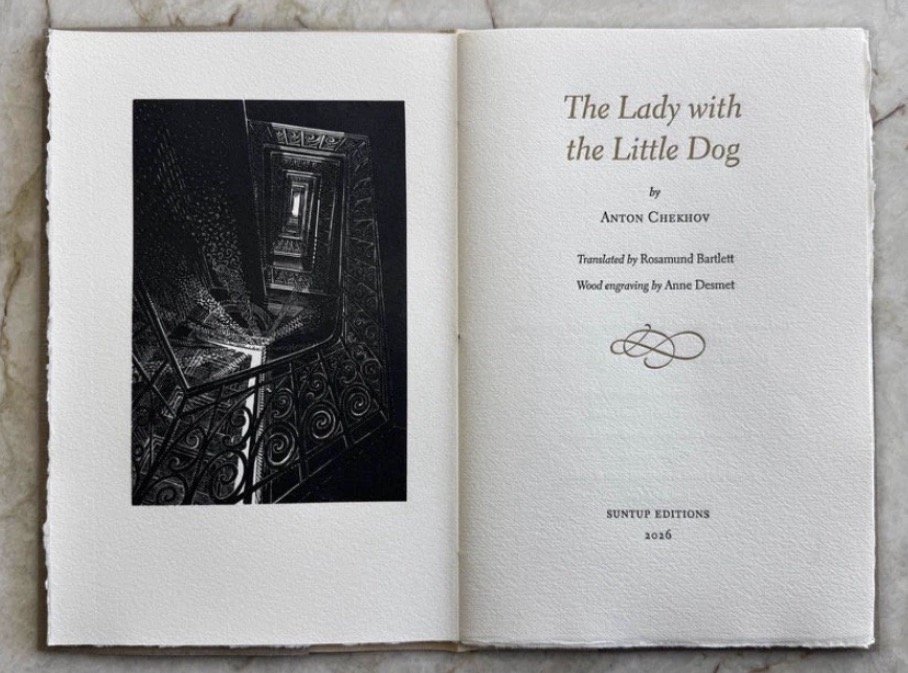 Image 2 of 3
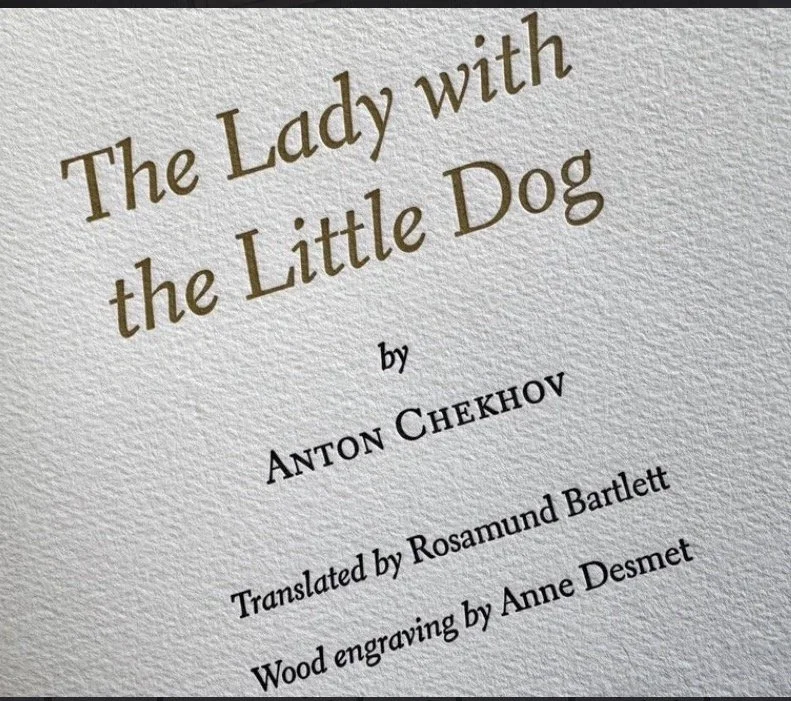 Image 3 of 3
First published in the journal Russkaya Mysl (Russian Thought) in December 1899, Anton Chekhov’s “The Lady with the Little Dog” is widely regarded as one of the greatest short stories ever written — a work that has shaped the art of the short story itself.
In the sun-drenched resort town of Yalta, a cynical and restless Moscow banker strikes up a flirtation with a young married woman walking her small white dog along the seafront. What begins as a casual holiday affair — one of many for him — deepens into something neither expected: a bond that is quiet, inconvenient, and inescapable.
Chekhov traces the slow unraveling of his characters’ assumptions about themselves with extraordinary delicacy, building not toward resolution but toward the recognition that real life, with all its difficulty, has only just begun.
About The Edition
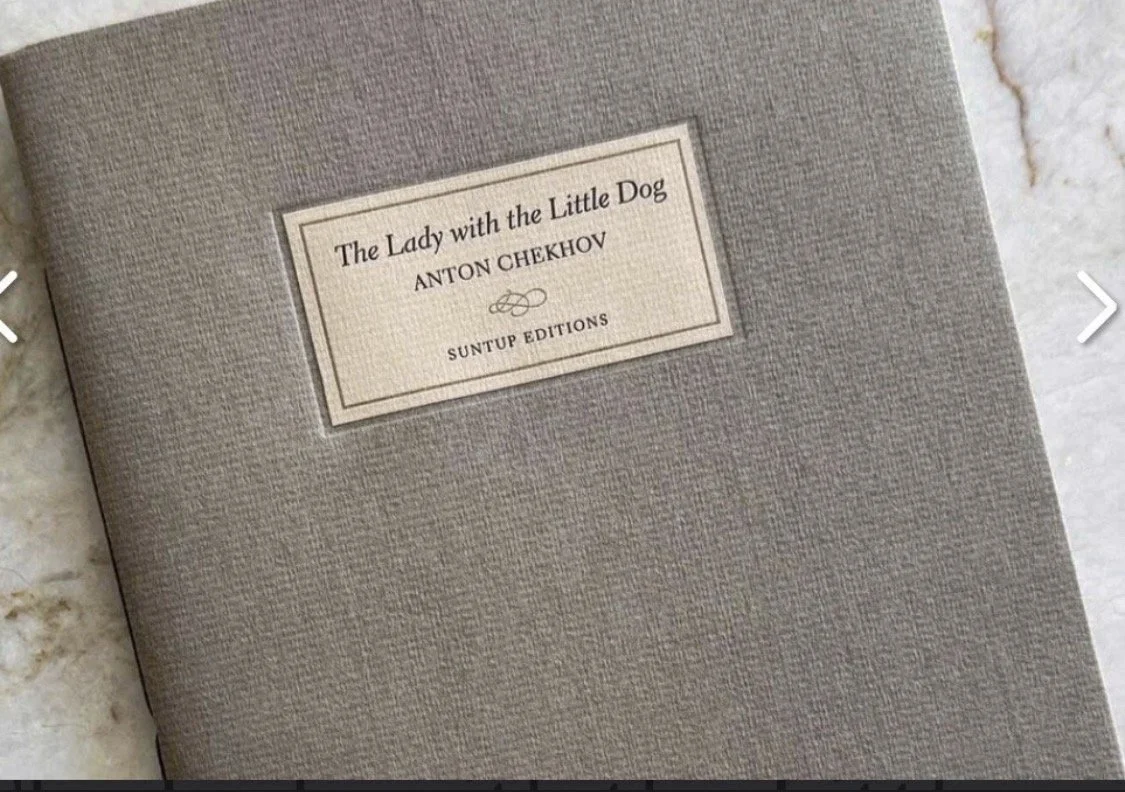
Our edition of “The Lady with the Little Dog” by Anton Chekhov is presented as part of our Short Story series in a single state of four hundred unnumbered copies with no rights attached. The edition measures 6½ × 9½ inches and features a wood engraving by Royal Academician Anne Desmet. The text is taken from Rosamund Bartlett’s translation, chosen for its fidelity to Chekhov’s language and tone.
It is designed by Scott Vile and printed letterpress on his Heidelberg Cylinder in Buxton, Maine on mouldmade Hahnemühle Biblio. The wood engraving is printed from the original block and the typeface is Electra. A second color appears on the title page and the opening initial, requiring additional passes through the press. The volume is 28 pages and is hand-sewn into a Hahnemühle Bugra wrapper with flaps by Nicoline Meyer in Hudson, New York and features a letterpress printed cover label. It is signed by the translator, artist and printer.
A Note on the Typography
The text is set in Electra, a serif typeface designed by W. A. Dwiggins and released by the Mergenthaler Linotype Company in 1935. Dwiggins described the design as a “modern roman type letter” with “personality,” avoiding direct revival of any historical model. He chose the name Electra to suggest electricity and crisp modernity. After a slow development process, Electra became a popular book typeface in American printing.
Anton Chekhov
Anton Chekhov (1860–1904) was a Russian playwright and short-story writer, widely considered one of the greatest writers of the modern era. He began his career writing comic sketches for humour magazines while studying medicine in Moscow, and went on to produce some of the most celebrated works in both forms, including the plays The Seagull, Three Sisters, and The Cherry Orchard, and dozens of stories that transformed the genre. He wrote “The Lady with the Little Dog” in 1899, five years before his death, while suffering from tuberculosis in the seaside town of Yalta, on the coast of the Black Sea — the very setting in which his two lovers meet. He died at forty-four in Badenweiler, Germany.