
 Image 1 of 1
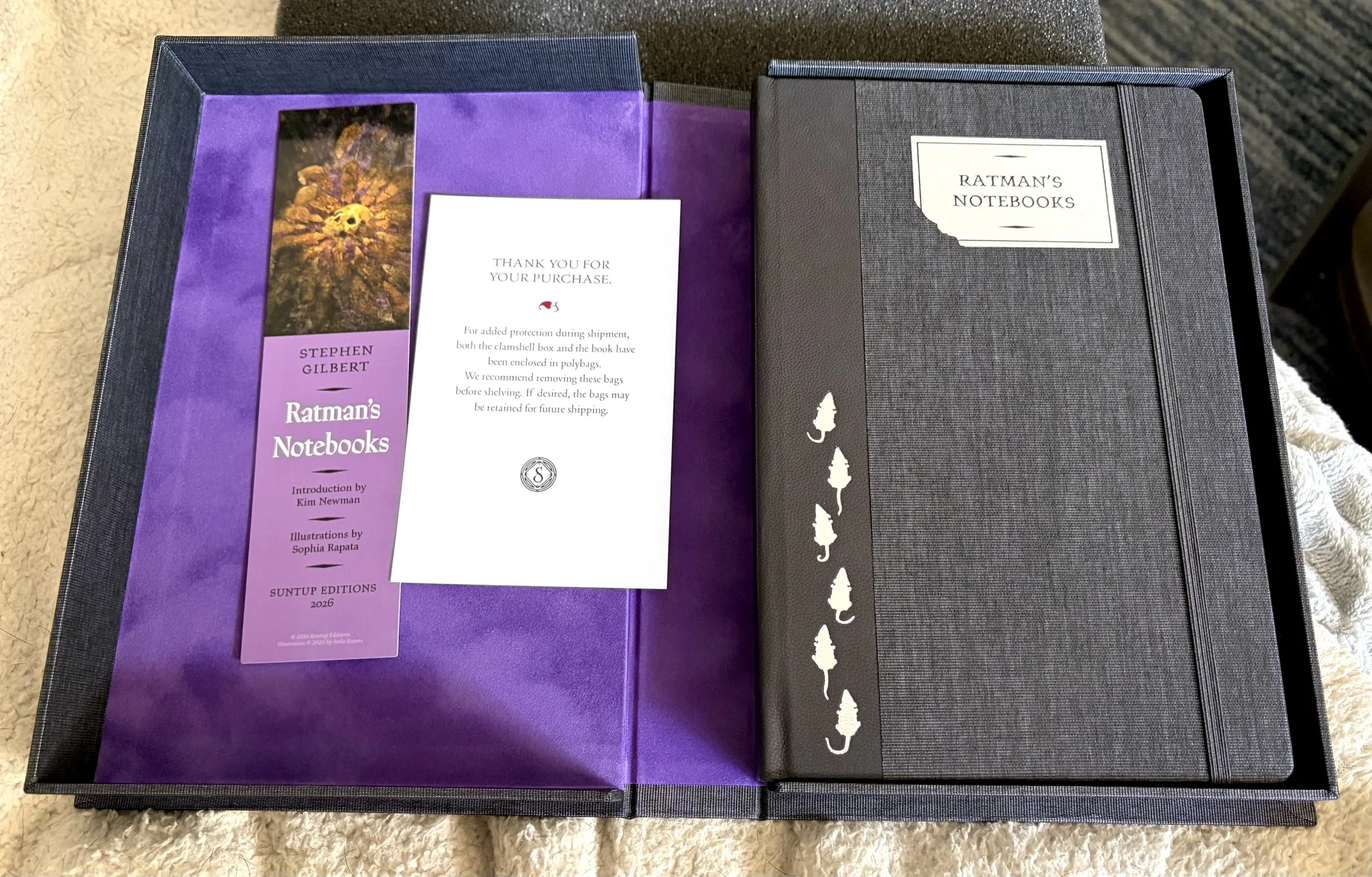
The Numbered edition of 250 copies is quarter bound in goatskin with cloth-covered boards and a ribbon marker, constructed as a flatback binding in a notebook-inspired style. A wraparound elastic closure runs vertically to hold the book shut. A die-cut paper label is affixed to the front cover, its corner deliberately shaped as though gnawed—an understated nod to the rats that haunt the story. Six rat silhouettes foil-blocked in silver are arranged vertically along the spine material where it extends onto the front board—echoing the slow, creeping advance of the story’s central infestation.
The overall design pays quiet homage to the novel’s form, drawing on the familiar materials and structure of a notebook. Endsheets are Hahnemühle Bugra and the book is housed in a clamshell enclosure covered in cloth with velour lined trays. It is printed on Mohawk Via Vellum paper and is signed by Kim Newman and Sophia Rapata.
The basis for the 1971 film Willard and its 2003 remake, Stephen Gilbert’s bestselling novel Ratman’s Notebooks was hailed by The Washington Star as “a horrific, grisly and truly frightening masterpiece of terror.” This is the first limited edition of the novel.
Presented through a series of journal entries, Ratman’s Notebooks follows an unnamed narrator—a reclusive misfit who finds himself alienated from the world around him. Working a thankless job at a company once owned by his late father and living under the thumb of a domineering mother, he drifts through life unnoticed and unloved. When his mother demands he exterminate a rat infestation, he sets out to do just that, but cannot bring himself to follow through. Instead, he begins to bond with the rats, earning their trust, training them, and ultimately forming a secret society of intelligent companions. As his connection to the human world continues to fray, his relationship with the rats deepens and he begins to see them as agents of vengeance. What begins as a quiet rebellion escalates into a chilling plan for revenge, as the narrator sets out to reclaim power in a world that has made him feel powerless.
Published in 1968, Ratman’s Notebooks became an immediate bestseller and was praised for its quiet horror and psychological intensity. New York Magazine called it “one of the more terrifying, deliciously scary thrillers,” while Kirkus Reviews described it as “a magnificently malignant horror story to which you will be unavoidably committed.” The Chattanooga Times hailed it as “a compelling tour de force,” and The Atlantic praised its “malevolent Gothic whimsy.” In his introduction, Kim Newman credits the novel’s success with helping legitimize horror as a mainstream literary genre, paving the way for the boom of the 1970s and the rise of authors like Stephen King and James Herbert.
A quietly terrifying portrait of alienation, obsession and the dark places loneliness can lead, Ratman’s Notebooks remains as eerie and chilling as the day it was first published.
The Numbered edition of 250 copies is quarter bound in goatskin with cloth-covered boards and a ribbon marker, constructed as a flatback binding in a notebook-inspired style. A wraparound elastic closure runs vertically to hold the book shut. A die-cut paper label is affixed to the front cover, its corner deliberately shaped as though gnawed—an understated nod to the rats that haunt the story. Six rat silhouettes foil-blocked in silver are arranged vertically along the spine material where it extends onto the front board—echoing the slow, creeping advance of the story’s central infestation.
The overall design pays quiet homage to the novel’s form, drawing on the familiar materials and structure of a notebook. Endsheets are Hahnemühle Bugra and the book is housed in a clamshell enclosure covered in cloth with velour lined trays. It is printed on Mohawk Via Vellum paper and is signed by Kim Newman and Sophia Rapata.
The basis for the 1971 film Willard and its 2003 remake, Stephen Gilbert’s bestselling novel Ratman’s Notebooks was hailed by The Washington Star as “a horrific, grisly and truly frightening masterpiece of terror.” This is the first limited edition of the novel.
Presented through a series of journal entries, Ratman’s Notebooks follows an unnamed narrator—a reclusive misfit who finds himself alienated from the world around him. Working a thankless job at a company once owned by his late father and living under the thumb of a domineering mother, he drifts through life unnoticed and unloved. When his mother demands he exterminate a rat infestation, he sets out to do just that, but cannot bring himself to follow through. Instead, he begins to bond with the rats, earning their trust, training them, and ultimately forming a secret society of intelligent companions. As his connection to the human world continues to fray, his relationship with the rats deepens and he begins to see them as agents of vengeance. What begins as a quiet rebellion escalates into a chilling plan for revenge, as the narrator sets out to reclaim power in a world that has made him feel powerless.
Published in 1968, Ratman’s Notebooks became an immediate bestseller and was praised for its quiet horror and psychological intensity. New York Magazine called it “one of the more terrifying, deliciously scary thrillers,” while Kirkus Reviews described it as “a magnificently malignant horror story to which you will be unavoidably committed.” The Chattanooga Times hailed it as “a compelling tour de force,” and The Atlantic praised its “malevolent Gothic whimsy.” In his introduction, Kim Newman credits the novel’s success with helping legitimize horror as a mainstream literary genre, paving the way for the boom of the 1970s and the rise of authors like Stephen King and James Herbert.
A quietly terrifying portrait of alienation, obsession and the dark places loneliness can lead, Ratman’s Notebooks remains as eerie and chilling as the day it was first published.