
 Image 1 of 2
 Image 2 of 2
Please note that I will ship these the day after I get them from Paul, which should be no later than July 12.
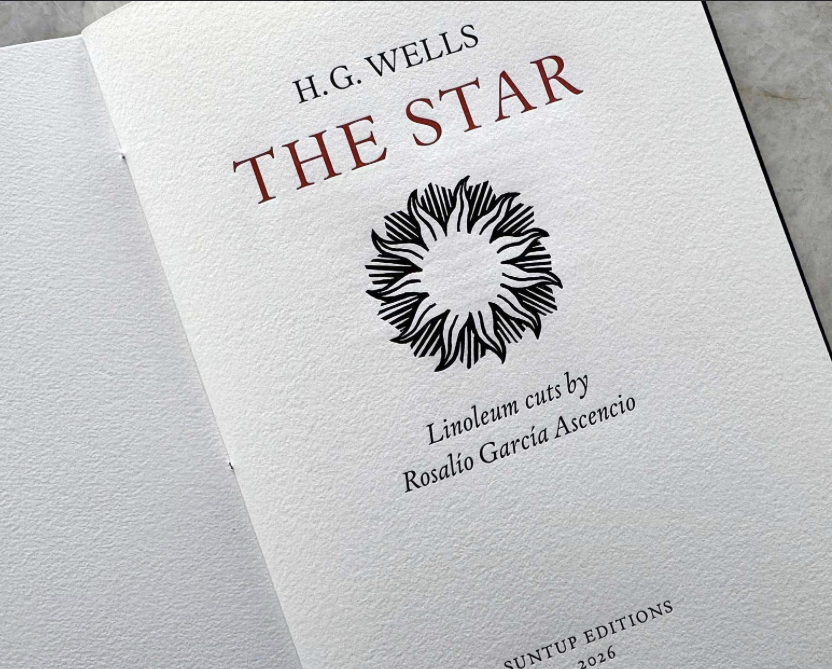
It is designed by Bradley Hutchinson and printed letterpress on his Heidelberg Cylinder in Austin, Texas on mouldmade Hahnemühle Biblio. The artwork is printed from the original blocks and the typeface is Espinosa Nova. The title and first page are printed in two colors, requiring two passes through the press. The volume is 24 pages and is hand sewn into Arches Cover wrappers by the printer and features a letterpress printed cover label. It is signed by the artist.
First published in the Christmas 1897 issue of The Graphic and collected two years later in Tales of Space and Time, H. G. Wells’s “The Star” stands as one of the earliest and most powerful works of apocalyptic science fiction in the English language.
A strange luminous body enters the solar system and collides with Neptune, forging a blazing new star that hurtles sunward, passing perilously close to Earth. As the celestial intruder draws nearer, its gravitational fury triggers earthquakes, tidal waves, and melting ice caps, while humanity cycles through wonder, denial, and terror.
Wells tells this story not through a single protagonist but through the collective voice of a world under siege—scientist and laborer, believer and skeptic—building a remorseless planetary tension that culminates in a final shift of perspective so coolly devastating it has haunted readers for more than a century.
Please note that I will ship these the day after I get them from Paul, which should be no later than July 12.
It is designed by Bradley Hutchinson and printed letterpress on his Heidelberg Cylinder in Austin, Texas on mouldmade Hahnemühle Biblio. The artwork is printed from the original blocks and the typeface is Espinosa Nova. The title and first page are printed in two colors, requiring two passes through the press. The volume is 24 pages and is hand sewn into Arches Cover wrappers by the printer and features a letterpress printed cover label. It is signed by the artist.
First published in the Christmas 1897 issue of The Graphic and collected two years later in Tales of Space and Time, H. G. Wells’s “The Star” stands as one of the earliest and most powerful works of apocalyptic science fiction in the English language.
A strange luminous body enters the solar system and collides with Neptune, forging a blazing new star that hurtles sunward, passing perilously close to Earth. As the celestial intruder draws nearer, its gravitational fury triggers earthquakes, tidal waves, and melting ice caps, while humanity cycles through wonder, denial, and terror.
Wells tells this story not through a single protagonist but through the collective voice of a world under siege—scientist and laborer, believer and skeptic—building a remorseless planetary tension that culminates in a final shift of perspective so coolly devastating it has haunted readers for more than a century.